British Blue or Russian Blue? I Chose a British Blue, But I Still Remember That Russian Blue
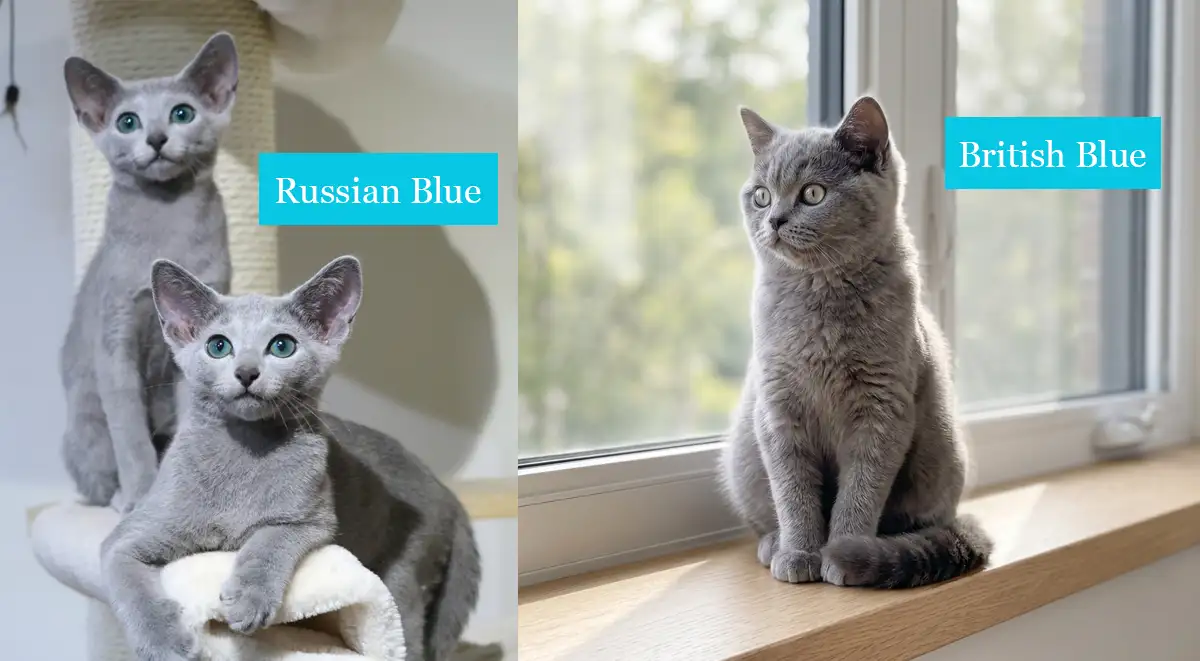
I’ve always loved blue-gray cats.
Before going to the shelter, I looked at lots of photos of British Blues and Russian Blues online. They were all blue-gray, but the descriptions gave me very different expectations about their personalities. At the time, I couldn’t tell which one would suit me better—I just thought they were all beautiful.
Then I met Bella. She’s a British Blue. I chose her.
But there was also a Russian Blue at the shelter. I caught a glimpse of her, and I’ve never forgotten her since.
I lived with Bella but only met the Russian Blue briefly. This is a comparison of what I saw, with the limits of that short meeting kept in view.
Different at First Sight
The first time I put Bella in her carrier, I was taken aback—she was much bigger than I’d imagined.
Bella: A Typical British Shorthair Build
British Blues do have a larger frame. With their short legs, broad chests, and round faces, they look like little balls of fluff, and they feel heavier in your arms than they appear.
A broad frame does not tell me whether a cat is carrying excess fat; body condition needs assessing separately.
I remember discussing her build at a checkup, but I cannot confirm her body-condition assessment at that visit. Her round appearance alone was not a health check.
The Russian Blue: Slender and Upright
The Russian Blue, on the other hand, was a completely different story.
She was standing at the back of her cage at the shelter, slender with long legs and an upright posture—unlike Bella, who liked to lie down. As I walked by, she glanced at me with a gentle movement, like a sheet of thin paper drifting across the floor.
With these two blue cats right in front of me, I could tell them apart instantly just by their size.
Their Coats Were Different, Too
Bella’s coat is thick, dense, and stiff—it feels like thick velvet to the touch. When I pet her, it feels substantial because she has such a thick coat, with a layer of undercoat underneath.
She sheds heavily, too; during seasonal changes, the whole house is covered in gray-blue clumps of fur.
The Russian Blue’s fur is finer, shorter, and shinier. I’d stroked that Russian Blue at the shelter once—through the cage, she walked over, and I reached out to touch her back.
Her fur was smooth, like satin, not the thick, substantial feel of Bella’s. That brief touch could not tell me how much she shed at home.
Personality Differences: Why I Chose Bella
Online sources describe British Blues as “affectionate and adaptable.”
Bella often seems gentle with me. But she isn’t particularly “affectionate” toward strangers.
When friends come over:
- She hides and waits several hours before slowly emerging
- She sits at a distance and watches, never approaching on her own
- She’s affectionate only toward me
It wasn’t until after I’d had her for over a year that she started to relax a bit around my friends—but she still doesn’t rub up against them on her own.
“Adaptable” isn’t entirely accurate either. She gets anxious in new environments; when we moved once, she hid under the bed for two days and wouldn’t come out. She’s not the kind of cat that can “sleep anywhere.”
But she’s very steady.
I value the quiet times when she stays beside me, occasionally rubbing against my hand before walking away. She can also demand attention or object to handling, as I have described elsewhere.
This personality is just right for me—I need a quiet roommate, not a cat that demands attention 24 hours a day.
What About That Russian Blue?
I didn’t get to know her very well. For most of my visit she stayed toward the back of her cage, quiet and watchful; she came closer during the brief moment when I touched her coat. The staff described her as timid and needing patience.
Later, I saw on the shelter’s website that she’d been adopted. I don’t know how she’s doing now. But I sometimes wonder if I’d chosen her back then, it might have taken longer for us to build a bond.
A Friend’s Russian Blue
I have a friend who owns a Russian Blue.
Her cat is a female, almost three years old. My friend says the cat only recognizes her—when strangers come over, the cat hides straight away in the bedroom and doesn’t come out all day.
She said her cat is quite different from Bella—at least Bella would come out to eat something when strangers visited, whereas her cat wouldn’t show her face at all.
My friend’s cat seemed more cautious around visitors than Bella. That says something about those two cats in those visits, not which breed is more loyal.
Health-wise, I Asked the Vet
Bella’s weight has always been a concern of mine.
British Blues are indeed prone to weight gain. Bella was overweight at one point, and the vet told me several times to control her diet. Now:
- Her daily food portions are weighed
- Her treats are strictly limited
- Weighing her once a week remains a regular habit
That is how I describe Bella’s routine, not a feeding plan for another cat. Portions and monitoring should suit the individual.
Living with Bella made me take routine care seriously. Her current weight needs a dated measurement; the old figures in my stories are not a current health assessment.
My friend described her Russian Blue as having no weight problems. That does not establish a special metabolism or mean unlimited food is safe. Cornell’s feeding guidance recommends individual weight and diet assessment.
I cannot substantiate the reassurance I recalled about Russian Blues having no major inherited diseases. Nor can I use Bella’s breed to prescribe constant heart and kidney checks. Ask the vet about the individual cat’s history and appropriate screening.
For either cat, I would ask for health records and an individual assessment rather than rely on a breed health guarantee.
In the End, I Chose Bella
It wasn’t because British Shorthairs are better than Russian Blues. It was simply because Bella glanced at me at the shelter, then walked over and rubbed against my hand.
At that moment, I knew she was the one.
It wasn’t until later that I gradually came to understand what Bella was like. Her calmness, her quiet nature, her wariness toward strangers yet her gradual openness toward those she trusts—these aren’t things I read online; they’re things I’ve come to experience only after living with Bella.
I still remember that short encounter, even though I only learned the cat had been adopted from a later notice.
If you’re choosing between them: compare the individual cats you can actually meet. Ask about their handling, visitor responses, diet and health history. Bella approached me; the Russian Blue mostly stayed back. Neither brief encounter could have predicted a lifetime together.